How to Read a Supplement Facts Label, Using HoneyPezil as the Example
Serving size, %DV, the double asterisk and 'other ingredients': a walkthrough of a real label.
A Supplement Facts panel tells you more than most marketing ever will, as long as you know how to read it. We'll use HoneyPezil's real label as the example.
1. Serving size and servings per container
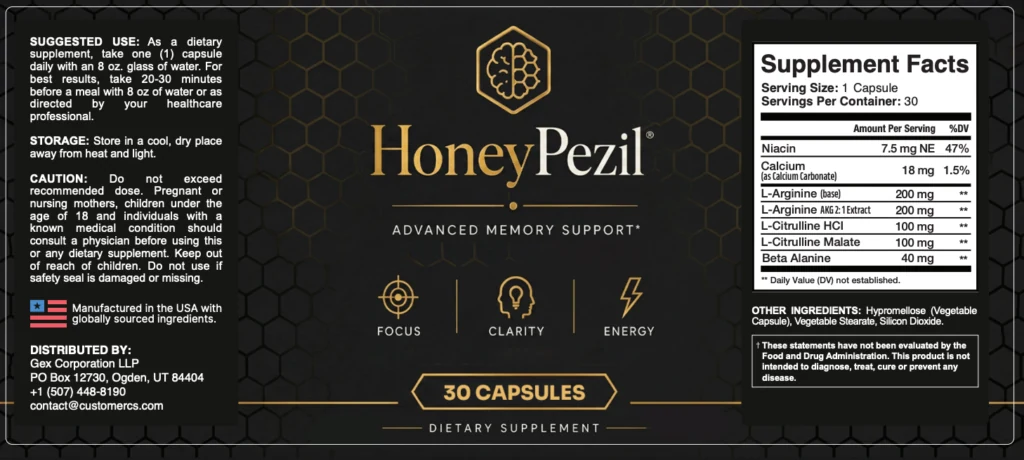
Start at the top. HoneyPezil lists Serving Size: 1 Capsule and Servings Per Container: 30. Every amount below is per serving, so one capsule, and the bottle lasts 30 days at the labeled dose.
2. Amount per serving
Each line shows how much of an ingredient one serving contains. On this label, every active ingredient has its own amount: 200 mg of L-arginine (base), 200 mg of L-arginine AKG, 100 mg each of two citrulline forms, 40 mg of beta-alanine, 7.5 mg NE of niacin and 18 mg of calcium. When a label lumps ingredients into a "proprietary blend" with one total, you can't see individual amounts. This label doesn't do that.
3. %DV and the double asterisk
%DV (percent Daily Value) shows how much of a reference daily amount one serving provides. Niacin is at 47% and calcium at 1.5%. Amino acids such as arginine have no established Daily Value, so the panel marks them "**", meaning not established.
4. Units: what does "mg NE" mean?
Niacin is measured in milligrams of niacin equivalents (NE). This unit accounts for the different forms of vitamin B3, including what your body can make from the amino acid tryptophan.
5. Other ingredients
Below the panel you'll find the non-active ingredients. For HoneyPezil these are hypromellose (the vegetable capsule shell), vegetable stearate and silicon dioxide, which are common capsule-making aids.
6. The fine print
The asterisk next to "Advanced Memory Support" points to the standard statement that the FDA has not evaluated these claims and that the product is not intended to diagnose, treat, cure or prevent any disease. The side panel adds directions, storage, cautions and the distributor's name and contact details.
Next, see what each ingredient is in our amino acid explainer, or go back to What Is It.